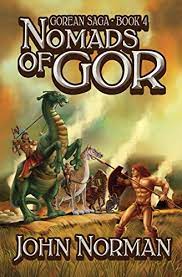
Book 4. (1 results) Nomads of Gor (Individual Quote)
| Chapter # | Sentence # | Quote |
|---|---|---|
| 15 | 10 | In the field the tuchuks would counter the tarnsmen by breaking open the Hundreds into scattered Tens and presenting only erratic, swiftly moving targets; it is difficult to strike a rider or beast at a distance from tarnback when he is well aware of you and ready to evade your missile; and, of course, did the tarnsman approach too closely, then he himself and his mount were exposed to the return fire of the tuchuks, in which case of proximity, the tuchuk could use his small bow to fierce advantage. |
 |
Book 4. (7 results) Nomads of Gor (Context Quote)
| Chapter # | Sentence # | Quote |
|---|---|---|
| 15 | 7 | Four times masses of tharlarion cavalry had charged forth from the city but each time the Hundreds withdrew before them until the charge had been enveloped in the swirling kaiila, and then its riders were brought down swiftly by the flashing arrows of the tuchuks, riding in closely, almost to lance range and firing again and again until striking home. |
| 15 | 8 | Several times also, hosts of tharlarion had attempted to protect caravans leaving the city, or advanced to meet scheduled caravans approaching Turia, but each time in spite of this support, the swift, harrying, determined riders of the tuchuks had forced the caravans to turn back, or man by man, beast by beast, left them scattered across pasangs of prairie. |
| 15 | 9 | The mercenary tarnsmen of Turia were most feared by the tuchuks, for such could, with relative impunity, fire upon them from the safety of their soaring height, but even this dread weapon of Turia could not, by itself, drive the tuchuks from the surrounding plains. |
| 15 | 10 | In the field the tuchuks would counter the tarnsmen by breaking open the Hundreds into scattered Tens and presenting only erratic, swiftly moving targets; it is difficult to strike a rider or beast at a distance from tarnback when he is well aware of you and ready to evade your missile; and, of course, did the tarnsman approach too closely, then he himself and his mount were exposed to the return fire of the tuchuks, in which case of proximity, the tuchuk could use his small bow to fierce advantage. |
| 15 | 11 | The archery of tarnsmen, of course, is most effective against massed infantry or clusters of the ponderous tharlarion. |
| 15 | 12 | Also, perhaps not unimportantly, many of Turia's mercenary tarnsmen found themselves engaged in the time-consuming, distasteful task of supplying the city from distant points, often bringing food and arrow wood from as far away as the valleys of the eastern Cartius. |
| 15 | 13 | I presume that the mercenaries, being tarnsmen—a proud, headstrong breed of men—made the Turians pay highly for the supplies they carried, the indignities of bearing burdens being lessened somewhat by the compensating weight of golden tarn disks. |
|
Four times masses of tharlarion cavalry had charged forth from the city but each time the Hundreds withdrew before them until the charge had been enveloped in the swirling kaiila, and then its riders were brought down swiftly by the flashing arrows of the tuchuks, riding in closely, almost to lance range and firing again and again until striking home.
Several times also, hosts of tharlarion had attempted to protect caravans leaving the city, or advanced to meet scheduled caravans approaching Turia, but each time in spite of this support, the swift, harrying, determined riders of the tuchuks had forced the caravans to turn back, or man by man, beast by beast, left them scattered across pasangs of prairie.
The mercenary tarnsmen of Turia were most feared by the tuchuks, for such could, with relative impunity, fire upon them from the safety of their soaring height, but even this dread weapon of Turia could not, by itself, drive the tuchuks from the surrounding plains.
In the field the tuchuks would counter the tarnsmen by breaking open the Hundreds into scattered Tens and presenting only erratic, swiftly moving targets; it is difficult to strike a rider or beast at a distance from tarnback when he is well aware of you and ready to evade your missile; and, of course, did the tarnsman approach too closely, then he himself and his mount were exposed to the return fire of the tuchuks, in which case of proximity, the tuchuk could use his small bow to fierce advantage.
The archery of tarnsmen, of course, is most effective against massed infantry or clusters of the ponderous tharlarion.
Also, perhaps not unimportantly, many of Turia's mercenary tarnsmen found themselves engaged in the time-consuming, distasteful task of supplying the city from distant points, often bringing food and arrow wood from as far away as the valleys of the eastern Cartius.
I presume that the mercenaries, being tarnsmen—a proud, headstrong breed of men—made the Turians pay highly for the supplies they carried, the indignities of bearing burdens being lessened somewhat by the compensating weight of golden tarn disks.
- (Nomads of Gor, Chapter 15)