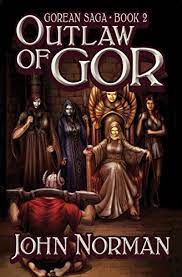
Book 2. (1 results) Outlaw of Gor (Individual Quote)
| Chapter # | Sentence # | Quote |
|---|---|---|
| 12 | 78 | Poets on Gor, as in my native world, were regarded with some skepticism and thought to be a little foolish, but it had not occurred to anyone that they might suffer from divine madness or be the periodic recipients of the inspiration of the gods. |
 |
Book 2. (7 results) Outlaw of Gor (Context Quote)
| Chapter # | Sentence # | Quote |
|---|---|---|
| 12 | 75 | On Gor, the singer, or poet, is regarded as a craftsman who makes strong sayings, much like a pot-maker makes a good pot or a saddle-maker makes a worthy saddle. |
| 12 | 76 | He has his role to play in the social structure, celebrating battles and histories, singing of heroes and cities, but also he is expected to sing of living, and of love and joy, not merely of arms and glory; and, too, it is his function to remind the Goreans from time to time of loneliness and death, lest they should forget that they are men. |
| 12 | 77 | The singer was thought to have an unusual skill, but so, too, were the tarn-keeper and the woodsman. |
| 12 | 78 | Poets on Gor, as in my native world, were regarded with some skepticism and thought to be a little foolish, but it had not occurred to anyone that they might suffer from divine madness or be the periodic recipients of the inspiration of the gods. |
| 12 | 79 | The Priest-Kings of Gor, who served as the divinities of this rude planet, inspired little but awe, and occasionally fear. |
| 12 | 80 | Men lived in a truce with the Priest-Kings, keeping their laws and festivals, making the required sacrifices and libations, but, on the whole, forgetting about them as much as possible. |
| 12 | 81 | Had it been suggested to a poet that he had been inspired by a Priest-King the fellow would have been scandalized. |
|
On Gor, the singer, or poet, is regarded as a craftsman who makes strong sayings, much like a pot-maker makes a good pot or a saddle-maker makes a worthy saddle.
He has his role to play in the social structure, celebrating battles and histories, singing of heroes and cities, but also he is expected to sing of living, and of love and joy, not merely of arms and glory; and, too, it is his function to remind the Goreans from time to time of loneliness and death, lest they should forget that they are men.
The singer was thought to have an unusual skill, but so, too, were the tarn-keeper and the woodsman.
Poets on Gor, as in my native world, were regarded with some skepticism and thought to be a little foolish, but it had not occurred to anyone that they might suffer from divine madness or be the periodic recipients of the inspiration of the gods.
The Priest-Kings of Gor, who served as the divinities of this rude planet, inspired little but awe, and occasionally fear.
Men lived in a truce with the Priest-Kings, keeping their laws and festivals, making the required sacrifices and libations, but, on the whole, forgetting about them as much as possible.
Had it been suggested to a poet that he had been inspired by a Priest-King the fellow would have been scandalized.
- (Outlaw of Gor, Chapter 12)