Book 2. (1 results) Outlaw of Gor (Individual Quote)
| Chapter # | Sentence # | Quote |
|---|---|---|
| 6 | 31 | I rejoiced that in at least one city on Gor the free women were not expected to wear the Robes of Concealment, confine their activities largely to their own quarters, and speak only to their blood relatives and, eventually, the free companion. |
 |
Book 2. (7 results) Outlaw of Gor (Context Quote)
| Chapter # | Sentence # | Quote |
|---|---|---|
| 6 | 28 | Indeed, in Gorean the same word is used for both stranger and enemy. |
| 6 | 29 | There was reputedly one exception to this generally prevalent attitude of hostility toward the stranger, the city of Tharna, which, according to rumor, was willing to engage in what on Gor might be accounted the adventure of hospitality. |
| 6 | 30 | There were many things supposedly strange about Tharna, among them that she was reportedly ruled by a queen, or Tatrix, and, reasonably enough in the circumstances, that the position of women in that city, in contrast with common Gorean custom, was one of privilege and opportunity. |
| 6 | 31 | I rejoiced that in at least one city on Gor the free women were not expected to wear the Robes of Concealment, confine their activities largely to their own quarters, and speak only to their blood relatives and, eventually, the free companion. |
| 6 | 32 | I thought that much of the barbarity of Gor might perhaps be traced to this foolish suppression of the fair sex, whose gentleness and intelligence might have made such a contribution in softening her harsh ways. |
| 6 | 33 | To be sure, in certain cities, as had been the case in Ko-ro-ba, women were permitted status within the caste system and had a relatively unrestricted existence. |
| 6 | 34 | Indeed, in Ko-ro-ba, a woman might even leave her quarters without first obtaining the permission of a male relative or the free companion, a freedom which was unusual on Gor. |
|
Indeed, in Gorean the same word is used for both stranger and enemy.
There was reputedly one exception to this generally prevalent attitude of hostility toward the stranger, the city of Tharna, which, according to rumor, was willing to engage in what on Gor might be accounted the adventure of hospitality.
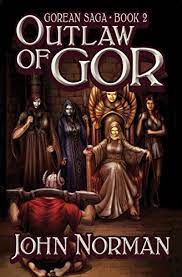
There were many things supposedly strange about Tharna, among them that she was reportedly ruled by a queen, or Tatrix, and, reasonably enough in the circumstances, that the position of women in that city, in contrast with common Gorean custom, was one of privilege and opportunity.
I rejoiced that in at least one city on Gor the free women were not expected to wear the Robes of Concealment, confine their activities largely to their own quarters, and speak only to their blood relatives and, eventually, the free companion.
I thought that much of the barbarity of Gor might perhaps be traced to this foolish suppression of the fair sex, whose gentleness and intelligence might have made such a contribution in softening her harsh ways.
To be sure, in certain cities, as had been the case in Ko-ro-ba, women were permitted status within the caste system and had a relatively unrestricted existence.
Indeed, in Ko-ro-ba, a woman might even leave her quarters without first obtaining the permission of a male relative or the free companion, a freedom which was unusual on Gor.
- (Outlaw of Gor, Chapter 6)