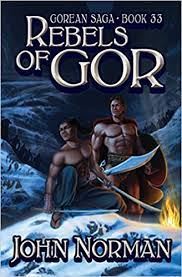
Book 33. (1 results) Rebels of Gor (Individual Quote)
| Chapter # | Sentence # | Quote |
|---|---|---|
| 21 | 76 | The possibility had suggested itself to some, a possibility which seemed plausible to me, that the Kurii, frustrated at the current failure of their designs, and the Priest-Kings, annoyed by probes, and predatory intrusions, might be willing to gamble for a world's surface, which space was seldom traversed by Priest-Kings, and then, commonly, only after the setting of Tor-tu-Gor, Light Upon the home stone, whose bright, piercing rays would dazzle and blind their sensory organs, and whose heat at certain seasons and in certain latitudes could scarcely be tolerated by their fragile, delicate bodies. |
 |
Book 33. (7 results) Rebels of Gor (Context Quote)
| Chapter # | Sentence # | Quote |
|---|---|---|
| 21 | 73 | Shortly thereafter the Goreans of the continental coast, particularly that in the vicinity of Brundisium, found strangers in their midst, Pani, these survivors of the major land forces of Lord Temmu. |
| 21 | 74 | These Pani, as I had determined, were as unclear as to the nature of their arrival on a foreign shore, as were those amongst whom they had found themselves. |
| 21 | 75 | It was obvious, given the technologies involved in such a suspension of consciousness and such a methodology of transition that either the Priest-Kings or the Kurii, or both, had chosen to intervene in what might otherwise have been regarded as little more than a final battle in a minor war in a far place, but why would they have done so? It was my surmise, based largely on intelligences more suspected than delivered in Tarncamp, that the matter had to do with the contest for Gor, or its surface, long waged by Priest-Kings and Kurii, a contest in which an acquisitive and aggressive species sought conquest and victory, and an ensconced species was content to satisfy itself with little more than the defense and protection of its world. |
| 21 | 76 | The possibility had suggested itself to some, a possibility which seemed plausible to me, that the Kurii, frustrated at the current failure of their designs, and the Priest-Kings, annoyed by probes, and predatory intrusions, might be willing to gamble for a world's surface, which space was seldom traversed by Priest-Kings, and then, commonly, only after the setting of Tor-tu-Gor, Light Upon the home stone, whose bright, piercing rays would dazzle and blind their sensory organs, and whose heat at certain seasons and in certain latitudes could scarcely be tolerated by their fragile, delicate bodies. |
| 21 | 77 | Accordingly, it was surmised, at least by some, that a wager had been made, with humans the cast dice on which the fate of the surface of a world might hang. |
| 21 | 78 | If the dice fell in favor of the bestial Kurii, the Priest-Kings would surrender to their intrusion and habitation the surface of their world, and should the dice fall in favor of the Priest-Kings, the Kurii would withdraw to their steel worlds, to live in peace, or seek another star. |
| 21 | 79 | I had no idea whether or not these speculations were grounded in reality, or were no more than the arrant conjectures of an ignorant few who were, perhaps, as little aware of the springs and engines on which the world turned as the grazing tabuk feeding in the meadows, the sheltering wood nearby, or, within that forest, the stolid tarsk turning the soil with its tusks, digging for roots. |
|
Shortly thereafter the Goreans of the continental coast, particularly that in the vicinity of Brundisium, found strangers in their midst, Pani, these survivors of the major land forces of Lord Temmu.
These Pani, as I had determined, were as unclear as to the nature of their arrival on a foreign shore, as were those amongst whom they had found themselves.
It was obvious, given the technologies involved in such a suspension of consciousness and such a methodology of transition that either the Priest-Kings or the Kurii, or both, had chosen to intervene in what might otherwise have been regarded as little more than a final battle in a minor war in a far place, but why would they have done so? It was my surmise, based largely on intelligences more suspected than delivered in Tarncamp, that the matter had to do with the contest for Gor, or its surface, long waged by Priest-Kings and Kurii, a contest in which an acquisitive and aggressive species sought conquest and victory, and an ensconced species was content to satisfy itself with little more than the defense and protection of its world.
The possibility had suggested itself to some, a possibility which seemed plausible to me, that the Kurii, frustrated at the current failure of their designs, and the Priest-Kings, annoyed by probes, and predatory intrusions, might be willing to gamble for a world's surface, which space was seldom traversed by Priest-Kings, and then, commonly, only after the setting of Tor-tu-Gor, Light Upon the home stone, whose bright, piercing rays would dazzle and blind their sensory organs, and whose heat at certain seasons and in certain latitudes could scarcely be tolerated by their fragile, delicate bodies.
Accordingly, it was surmised, at least by some, that a wager had been made, with humans the cast dice on which the fate of the surface of a world might hang.
If the dice fell in favor of the bestial Kurii, the Priest-Kings would surrender to their intrusion and habitation the surface of their world, and should the dice fall in favor of the Priest-Kings, the Kurii would withdraw to their steel worlds, to live in peace, or seek another star.
I had no idea whether or not these speculations were grounded in reality, or were no more than the arrant conjectures of an ignorant few who were, perhaps, as little aware of the springs and engines on which the world turned as the grazing tabuk feeding in the meadows, the sheltering wood nearby, or, within that forest, the stolid tarsk turning the soil with its tusks, digging for roots.
- (Rebels of Gor, Chapter 21)