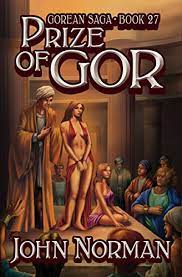
Book 27. (1 results) Prize of Gor (Individual Quote)
| Chapter # | Sentence # | Quote |
|---|---|---|
| 18 | 134 | In its way, the collar has some of the symbolic aspects of the marriage ring, except, of course, that that ring is a symbol worn by a free woman who is the putative equal of a man, whereas the collar is worn by a slave, and, aside from such things as its identificatory purposes, important in merchant law, is a symbol of the natural woman, the woman who is categorically owned by a man, her master. |
 |
Book 27. (7 results) Prize of Gor (Context Quote)
| Chapter # | Sentence # | Quote |
|---|---|---|
| 18 | 131 | It pleased her, somehow, to be naked and collared. |
| 18 | 132 | The nakedness suggested her vulnerability and, very much, her femaleness. |
| 18 | 133 | The collar gave her a sense of belonging, a sense of security; too, it was, in its way, a proclamation of her value; it testified that men wanted her, that she had been found fair enough to collar, that she was desired as a female, that she had been found worth enslaving; too, it made it clear, to her and others, that certain issues of her life had been settled for her, that she was already "spoken for," so to speak, that others need not think of her, that she was already owned. |
| 18 | 134 | In its way, the collar has some of the symbolic aspects of the marriage ring, except, of course, that that ring is a symbol worn by a free woman who is the putative equal of a man, whereas the collar is worn by a slave, and, aside from such things as its identificatory purposes, important in merchant law, is a symbol of the natural woman, the woman who is categorically owned by a man, her master. |
| 18 | 135 | To be sure, it is one thing to be naked before the master, wearing only his collar, which you both know identifies you as his, and another thing to be naked in the streets. |
| 18 | 136 | Ellen was expected to run errands below, to shop, to do the laundry at the public laundering pools, and such. |
| 18 | 137 | In the first weeks she was not permitted clothing, only her collar. |
|
It pleased her, somehow, to be naked and collared.
The nakedness suggested her vulnerability and, very much, her femaleness.
The collar gave her a sense of belonging, a sense of security; too, it was, in its way, a proclamation of her value; it testified that men wanted her, that she had been found fair enough to collar, that she was desired as a female, that she had been found worth enslaving; too, it made it clear, to her and others, that certain issues of her life had been settled for her, that she was already "spoken for," so to speak, that others need not think of her, that she was already owned.
In its way, the collar has some of the symbolic aspects of the marriage ring, except, of course, that that ring is a symbol worn by a free woman who is the putative equal of a man, whereas the collar is worn by a slave, and, aside from such things as its identificatory purposes, important in merchant law, is a symbol of the natural woman, the woman who is categorically owned by a man, her master.
To be sure, it is one thing to be naked before the master, wearing only his collar, which you both know identifies you as his, and another thing to be naked in the streets.
Ellen was expected to run errands below, to shop, to do the laundry at the public laundering pools, and such.
In the first weeks she was not permitted clothing, only her collar.
- (Prize of Gor, Chapter 18)