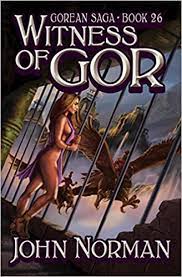
Book 26. (1 results) Witness of Gor (Individual Quote)
| Chapter # | Sentence # | Quote |
|---|---|---|
| 16 | 201 | Then it seemed I was alone with the dance, and my joy in it. |
 |
Book 26. (7 results) Witness of Gor (Context Quote)
| Chapter # | Sentence # | Quote |
|---|---|---|
| 16 | 198 | I then, in my dance, utilized the corners and surfaces of chests, and the walls of the room. |
| 16 | 199 | I saw, beside the divan, a coil of chain. |
| 16 | 200 | I danced away from it, terrified. |
| 16 | 201 | Then it seemed I was alone with the dance, and my joy in it. |
| 16 | 202 | And then, a moment later, wildly, it seemed again that I must dance for many. |
| 16 | 203 | Did I hear the striking of the shoulders in applause, the pounding of goblets on low tables, the urgent cries of men? What power, I thought, must a dancer, a true dancer, exercise over men! How she must arouse them, how she must drive them mad with passion! But what power, ultimately, is hers, for she is in her collar? When the music stops is she not then, clearly, once again, only a slave at the feet of men? And is not the central, nonrepudiable message of this dance, in its entire concept, in its beauty, in its presentation of the female in all her marvelous sensuousness, that man is the master? This form of dance, on this world, is called "slave dance". |
| 16 | 204 | That is perhaps partly because, on this world, it is permitted only to slaves, but I think it is more likely because, in it, the nature of woman is clearly manifested as slave. |
|
I then, in my dance, utilized the corners and surfaces of chests, and the walls of the room.
I saw, beside the divan, a coil of chain.
I danced away from it, terrified.
Then it seemed I was alone with the dance, and my joy in it.
And then, a moment later, wildly, it seemed again that I must dance for many.
Did I hear the striking of the shoulders in applause, the pounding of goblets on low tables, the urgent cries of men? What power, I thought, must a dancer, a true dancer, exercise over men! How she must arouse them, how she must drive them mad with passion! But what power, ultimately, is hers, for she is in her collar? When the music stops is she not then, clearly, once again, only a slave at the feet of men? And is not the central, nonrepudiable message of this dance, in its entire concept, in its beauty, in its presentation of the female in all her marvelous sensuousness, that man is the master? This form of dance, on this world, is called "slave dance".
That is perhaps partly because, on this world, it is permitted only to slaves, but I think it is more likely because, in it, the nature of woman is clearly manifested as slave.
- (Witness of Gor, Chapter 16)