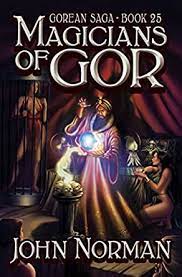
Book 25. (1 results) Magicians of Gor (Individual Quote)
| Chapter # | Sentence # | Quote |
|---|---|---|
| 17 | 30 | It might also be noted, interestingly, that the Gorean, in spite of his awe of Priest-Kings, and the reverence he accords them, the gods of his world, does not think of them as having formed the world, nor of the world being in some sense consequent upon their will. |
 |
Book 25. (7 results) Magicians of Gor (Context Quote)
| Chapter # | Sentence # | Quote |
|---|---|---|
| 17 | 27 | He paints eyes upon his ships, that they may see their way. |
| 17 | 28 | And if he feels so even about his vessels, then so much more the awed and reverent must he feel when he contemplates the immensity and grandeur, the beauty, the power and the mightiness within which he finds himself. |
| 17 | 29 | Why is there anything? Why is there anything at all? Why not just nothing? Wouldn't "nothing" be more likely, more rational, more scientific? When did time begin? Where does space end? On a line, at the surface of a sphere? Do our definitions constrain reality? What if reality does not know our language, the boundaries of our perceptions, the limitations of our minds? How is it that one wills to raise one's hand and the hand rises? How is it that an aggregation of molecules can cry out with joy in the darkness? The Gorean sees the world less as a puzzle than an opportunity, less as a datum to be explained than a bounty in which to rejoice, less as a problem to be solved than a gift to be gratefully received. |
| 17 | 30 | It might also be noted, interestingly, that the Gorean, in spite of his awe of Priest-Kings, and the reverence he accords them, the gods of his world, does not think of them as having formed the world, nor of the world being in some sense consequent upon their will. |
| 17 | 31 | Rather the Priest-Kings are seen as being its children, too, like sleen, and rain and man. |
| 17 | 32 | A last observation having to do with the tendency of some Goreans to accept illusions and such as reality is that the Gorean tends to take such things as honor and truth very seriously. |
| 17 | 33 | Given his culture and background, his values, he is often easier to impose upon than would be many others. |
|
He paints eyes upon his ships, that they may see their way.
And if he feels so even about his vessels, then so much more the awed and reverent must he feel when he contemplates the immensity and grandeur, the beauty, the power and the mightiness within which he finds himself.
Why is there anything? Why is there anything at all? Why not just nothing? Wouldn't "nothing" be more likely, more rational, more scientific? When did time begin? Where does space end? On a line, at the surface of a sphere? Do our definitions constrain reality? What if reality does not know our language, the boundaries of our perceptions, the limitations of our minds? How is it that one wills to raise one's hand and the hand rises? How is it that an aggregation of molecules can cry out with joy in the darkness? The Gorean sees the world less as a puzzle than an opportunity, less as a datum to be explained than a bounty in which to rejoice, less as a problem to be solved than a gift to be gratefully received.
It might also be noted, interestingly, that the Gorean, in spite of his awe of Priest-Kings, and the reverence he accords them, the gods of his world, does not think of them as having formed the world, nor of the world being in some sense consequent upon their will.
Rather the Priest-Kings are seen as being its children, too, like sleen, and rain and man.
A last observation having to do with the tendency of some Goreans to accept illusions and such as reality is that the Gorean tends to take such things as honor and truth very seriously.
Given his culture and background, his values, he is often easier to impose upon than would be many others.
- (Magicians of Gor, Chapter 17)