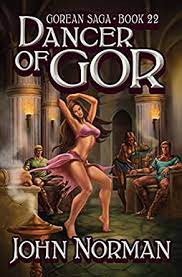
Book 22. (1 results) Dancer of Gor (Individual Quote)
| Chapter # | Sentence # | Quote |
|---|---|---|
| 20 | 184 | Citizenship, or its retention, on other than a nominal basis, in some cities, is contingent on such things as attending public ceremonies, such as an official semiannual taking of auspices, and participating in numerous public assemblies, some of which are called on short notice. |
 |
Book 22. (7 results) Dancer of Gor (Context Quote)
| Chapter # | Sentence # | Quote |
|---|---|---|
| 20 | 181 | "Yes, Master," I said, and hurried out to the street, where we had left the hand-drawn cart. |
| 20 | 182 | Whereas in the cities, where the rights of citizenship are clearest, where the sways of custom and tradition tend to be jealously guarded, where the influence of Home Stones is likely to be most keenly felt, free labor has generally held its own, the same cannot be said for all rural areas of Gor, particularly areas which fall outside the obvious jurisdiction or sphere of influence of nearby cities. |
| 20 | 183 | Too, it is difficult to be a citizen of a city if one cannot reach it within a day's march. |
| 20 | 184 | Citizenship, or its retention, on other than a nominal basis, in some cities, is contingent on such things as attending public ceremonies, such as an official semiannual taking of auspices, and participating in numerous public assemblies, some of which are called on short notice. |
| 20 | 185 | Accordingly, for various reasons, such as lack of citizenship, an inability to properly exercise it, resulting in effective disenfranchisement, or, most often, a fierce independence, repudiating allegiance to anything save one's own village, the farmers, or peasantry, are more likely to suffer from the results of cheap competition than their urban brethren. |
| 20 | 186 | In the last several years, the institution of the "great farm," with its projected contracts, its organization and planning, its agricultural expertise, and its embonded labor force has become more common on Gor. |
| 20 | 187 | Some Gorean farmers own their own land, and some share in land owned by a village. |
|
"Yes, Master," I said, and hurried out to the street, where we had left the hand-drawn cart.
Whereas in the cities, where the rights of citizenship are clearest, where the sways of custom and tradition tend to be jealously guarded, where the influence of Home Stones is likely to be most keenly felt, free labor has generally held its own, the same cannot be said for all rural areas of Gor, particularly areas which fall outside the obvious jurisdiction or sphere of influence of nearby cities.
Too, it is difficult to be a citizen of a city if one cannot reach it within a day's march.
Citizenship, or its retention, on other than a nominal basis, in some cities, is contingent on such things as attending public ceremonies, such as an official semiannual taking of auspices, and participating in numerous public assemblies, some of which are called on short notice.
Accordingly, for various reasons, such as lack of citizenship, an inability to properly exercise it, resulting in effective disenfranchisement, or, most often, a fierce independence, repudiating allegiance to anything save one's own village, the farmers, or peasantry, are more likely to suffer from the results of cheap competition than their urban brethren.
In the last several years, the institution of the "great farm," with its projected contracts, its organization and planning, its agricultural expertise, and its embonded labor force has become more common on Gor.
Some Gorean farmers own their own land, and some share in land owned by a village.
- (Dancer of Gor, Chapter 20)