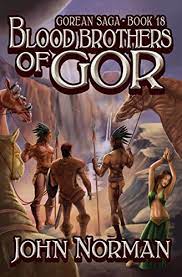
Book 18. (1 results) Blood Brothers of Gor (Individual Quote)
| Chapter # | Sentence # | Quote |
|---|---|---|
| 3 | 286 | In her dance, of course, Winyela was understood to be dancing not only her personal slavery, which she surely was, but, from the point of view of the Kaiila, in the symbolism of the dance, in the medicine of the dance, that the women of enemies were fit to be no more than the slaves of the Kaiila. |
 |
Book 18. (7 results) Blood Brothers of Gor (Context Quote)
| Chapter # | Sentence # | Quote |
|---|---|---|
| 3 | 283 | Too, it was little wonder that slaves, helpless in their collars, so feared and dreaded free women. |
| 3 | 284 | "The slave dances well," said Cuwignaka. |
| 3 | 285 | "Yes," I said. |
| 3 | 286 | In her dance, of course, Winyela was understood to be dancing not only her personal slavery, which she surely was, but, from the point of view of the Kaiila, in the symbolism of the dance, in the medicine of the dance, that the women of enemies were fit to be no more than the slaves of the Kaiila. |
| 3 | 287 | I did not doubt but what the Fleer and the Yellow Knives, and other peoples, too, might have similar ceremonies, in which, in one way or another, a similar profession might take place, there being danced or enacted also by a woman of another group, perhaps even, in those cases, by a maiden of the Kaiila. |
| 3 | 288 | I, myself, saw the symbolism of the dance, and, I think, so, too, did Winyela, in a pattern far deeper than that of an ethnocentric idiosyncrasy. |
| 3 | 289 | I saw the symbolism as being in accord with what is certainly one of the deepest and most pervasive themes of organic nature, that of dominance and submission. |
|
Too, it was little wonder that slaves, helpless in their collars, so feared and dreaded free women.
"The slave dances well," said Cuwignaka.
"Yes," I said.
In her dance, of course, Winyela was understood to be dancing not only her personal slavery, which she surely was, but, from the point of view of the Kaiila, in the symbolism of the dance, in the medicine of the dance, that the women of enemies were fit to be no more than the slaves of the Kaiila.
I did not doubt but what the Fleer and the Yellow Knives, and other peoples, too, might have similar ceremonies, in which, in one way or another, a similar profession might take place, there being danced or enacted also by a woman of another group, perhaps even, in those cases, by a maiden of the Kaiila.
I, myself, saw the symbolism of the dance, and, I think, so, too, did Winyela, in a pattern far deeper than that of an ethnocentric idiosyncrasy.
I saw the symbolism as being in accord with what is certainly one of the deepest and most pervasive themes of organic nature, that of dominance and submission.
- (Blood Brothers of Gor, Chapter 3)