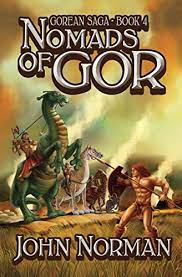
Book 4. (1 results) Nomads of Gor (Individual Quote)
| Chapter # | Sentence # | Quote |
|---|---|---|
| 2 | 107 | The head of the kaiila bears two large eyes, one on each side, but these eyes are triply lidded, probably an adaptation to the environment which occasionally is wracked by severe storms of wind and dust; the adaptation, actually a transparent third lid, permits the animal to move as it wishes under conditions that force other prairie animals to back into the wind or, like the sleen, to burrow into the ground. |
 |
Book 4. (7 results) Nomads of Gor (Context Quote)
| Chapter # | Sentence # | Quote |
|---|---|---|
| 2 | 104 | It requires less food, of course, than the tarn. |
| 2 | 105 | A kaiila, which normally stands about twenty to twenty-two hands at the shoulder, can cover as much as six hundred pasangs in a single day's riding. |
| 2 | 106 | * *The pasang, a common unit of Gorean land measurement, is approximately seven-tenths of a mile. |
| 2 | 107 | The head of the kaiila bears two large eyes, one on each side, but these eyes are triply lidded, probably an adaptation to the environment which occasionally is wracked by severe storms of wind and dust; the adaptation, actually a transparent third lid, permits the animal to move as it wishes under conditions that force other prairie animals to back into the wind or, like the sleen, to burrow into the ground. |
| 2 | 108 | The kaiila is most dangerous under such conditions, and, as if it knew this, often uses such times for its hunt. |
| 2 | 109 | Now the rider had reined in the kaiila. |
| 2 | 110 | He held his ground, waiting for the others. |
|
It requires less food, of course, than the tarn.
A kaiila, which normally stands about twenty to twenty-two hands at the shoulder, can cover as much as six hundred pasangs in a single day's riding.
* *The pasang, a common unit of Gorean land measurement, is approximately seven-tenths of a mile.
The head of the kaiila bears two large eyes, one on each side, but these eyes are triply lidded, probably an adaptation to the environment which occasionally is wracked by severe storms of wind and dust; the adaptation, actually a transparent third lid, permits the animal to move as it wishes under conditions that force other prairie animals to back into the wind or, like the sleen, to burrow into the ground.
The kaiila is most dangerous under such conditions, and, as if it knew this, often uses such times for its hunt.
Now the rider had reined in the kaiila.
He held his ground, waiting for the others.
- (Nomads of Gor, Chapter 2)